

Conception and goals of trees for people – Trees for the World ®
mother nursery and network
summary
The naturally occurring rain-green dry forest of north-western Namibia occurs in a mosaic of diverse vegetation units. The population of north-western Namibia has doubled in its tribal area in recent decades. Due to the enormously high demand for fire and construction wood by the population, the remaining forest residues are heavily used. Large areas of what used to be forest have already been deforested and the process continues. Through a targeted reforestation policy, the population of the rain-green dry forest can be maintained in the long term or even increased again.
1. Initial situation
The Trees for People Trees for the World ® mother nursery is located in Ondangwa, Oshana Region, North West Namibia, approximately 750 km N of Windhoek, north of Etosha National Park. The area, originally endowed with widespread dry raingreen forest, has been largely deforested over the past five decades. The situation in northwestern Namibia is reminiscent of a comparable situation in Germany in the Middle Ages, when large-scale afforestation was practiced. Forest and pasture experienced a clear separation. This enabled the state to prevent a shortage of wood and a drastic deterioration in living space that was spreading.
- Geography, geology, soils
Ondangwa is located in the center of a large-scale, very old depression (Owambo Basin), which is part of the much larger Kalahari Basin and has accumulated up to 500 meters thick fine sediments from rivers and shallow lakes over millions of years (Kalahari Sequence). At the top we find today sandy-clayey sediments from lakes, most of which have evaporated due to the already hot climate at that time. High concentrations of salts remained, which is why today the groundwater reservoirs are brackish to a large extent. Even today we find ourselves in a rather dry phase in which the Cuvelai River with its huge network of drainage channels, the Oshanas, transports sediments from higher areas in Angola into the Owambo Basin during flood events.
A lively mixture of different soils developed from the substrates, which were often relocated by water and wind. The sand mostly stayed on the heights or was transported there with the wind, while the silt and clay (clay) collected in the lower layers. The low fertility of the soil is typical of the arid conditions, since the sparse vegetation hardly brings any organic material into the soil. The low rate of new formation and the shallow depth of development of the soils are also characteristic.
The sandy soils, which are very salty due to the high rate of evaporation, often have clayey salt crusts at a depth of 10-50 cm below ground, which make working the soil almost impossible. Local flooding after heavy rain showers is due to the fact that the soil can no longer seep away. After rainfall, the salts in the hard crusts dissolve and migrate upwards, increasing salinity. Ondangwa lies at the interface between high (S) and moderate (N) salinity soils. The lower salinities occur in the higher areas that may have been flooded during previous wetter climates.
Scenically we are within the ‘Cuvelai’ where in the dry season extensive grassy steppes thrive in the Oshanas, while the higher parts of the landscape grow the mopane bush and various tall trees. Only here can agriculture with arable farming be practiced. In summary, the Ondangwa area is nonetheless in a potentially favorable region for land management in the Owambo Basin. The geographic term “Cuvelai” is also used below for north-western Namibia, which consists of the four political districts of Omusati, Ohangwena, Oshana and Oshikoto. This area is the Ovambo tribal area.
- Climate
The semi-arid climate is characterized by rainfall, which can vary greatly in amount and timing. Almost the entire annual precipitation (96%) falls from November to April (summer months), more than 2/3 of it from January to March. Ondangwa receives rainfall of 400-500mm/year. Temperatures are highest during the rainy season: 30-35° C. In winter Ondangwa is largely frost-free, the thermometer drops to 7-8° C. The potential evaporation is 2500 mm/year.
Especially during the rainy phase, the winds reach their highest speeds and additionally contribute to the evaporation of the water that is in the oshanas. In summary, it can be said that only plants that are specialized for arid conditions can survive under these conditions. The past 20 years have seen lower totals than the 1970s and wetter than the 1960s. High evaporation rates and high temperatures exacerbate the effects of restricted rainfall.
- Water
In a country as arid as Namibia, the presence of water has determined the whereabouts of humans and other creatures for centuries. The Cuvelai delta with its widely ramified channel system guaranteed the livelihood here. Before the population explosion at the turn of the 19th and 20th centuries, it was common here to use surface water as drinking water during the rainy season and shallow, hand-dug wells during the dry season. In very wet rainy seasons, which occur at intervals of 4-10 years, the Cuvelai Delta in the NW also reaches the vicinity of Ondangwa, resulting in large-scale floods (“efundjas”). However, a large part of the surface water that occurs results from local precipitation (such as the ponds in the tree nursery).
The groundwater level around Ondangwa is 10-20 m below ground level. The relatively flat groundwater body would be very favorable as a drinking water reservoir if the high degree of salinity, which is still below 1000 mg/l to the east of Ondangwa and reaches over 5000 mg/l to the west of it, meant that potable drinking water was in short supply. Drinking water for Ondangwa and much of the population of north-western Namibia comes from the Calueque Dam on the Kunene River in Angola (near Ruacana, in the extreme NW), built in the 1970s. It is therefore also in Namibia’s interest to ensure the cleanliness and safety of the Kunene River in Angola.
All tap water reaches the consumer via a complicated canal system that goes to Oshakati, and then via pipelines, who can now draw on an extensive network of pipes in central north-western Namibia. The priority in recent years has been to provide water to every citizen within a maximum distance of 2.5 km. Nonetheless, water from shallow wells or the Oshanas is often used as drinking water.
2. Population
Around 100,000 people lived in the Cuvelai Delta area at the beginning of the 20th century. There were extreme famines: it is estimated that about 40% of the population died in 1907-08. The population increase, which has mainly been recorded since Namibian and Angolan independence, reached 2.8% per year between 1980 and 1991. It will drop to around 2% in the next few years due to disease and migration, so that in 2021 around a million people will live there. While the delta makes up only about 10% of Namibia’s area, it is home to almost 50% of the population (2000). The Ohangwena region, which also includes Ondangwa, has over 200,000 inhabitants.
Migration plays a major role in the Cuvelai. One of the main reasons for this is the lack of work, which causes men in particular to migrate from rural regions to cities in the south (especially Windhoek), so that there is a clear surplus of women of working age in north-western Namibia. But there is also a significant migration to the cities in the north, so that eg Ondangwa grew from 1000 inhabitants in 1981 to 7900 in 1991.
Even if the network of hospitals and medical centers is already quite dense, medical care is still not sufficient for many people. According to a 1998 analysis, around 24% of the population is infected with HIV. This will cause dramatic falls in the population in the coming years. It is estimated that by 2010 around 140,000 people will have died from it. Life expectancy will drop from the current 60-65 years to 38-40 years in 2011. In addition to tuberculosis and malaria, illnesses caused by the use of impure drinking water (surface water) (diarrhea, schistosomiasis) also occur frequently.
School education is taken very seriously by the population. Around 95% of all children and young people attend school up to the age of 16. Secondary schools include the Ogongo Agricultural College.
3. Agriculture
Ondangwa constituency is located in Oshana region, the capital of which is Oshakati. Ondangwa is located in a communal area where mainly smallholder farmers cultivate the land. About 30 km further to the S and SW begins the area that is ruled by tribal elders and princes and three kings. A small farmer’s land is usually divided into two parts: cultivated land and pasture land or “forest” (“uunyanda”). The farmland and the living quarters are each protected with palisade walls from being bitten by cattle. The knowledge of the cultivation possibilities of the different soils, especially in the area of the Oshanas, is generally high among the farmers.
Almost every small farmer grows mahango or millet, a type of millet, ie it grows on 90% of the cultivated area in Owamboland. Sorghum grows on almost 10% of the area, and is used as a breakfast grain and for beer production. It gets more colorful on small areas: melons, peas (“cow peas”), bambra nuts, beans, pumpkins and peanuts are harvested there. Artificial irrigation is only available on the larger farms near Tsumeb. It is also possible to grow corn and sunflowers there.
The size and success of a farm depends very much on the wealth and size of a household. Mostly subsistence farming is practiced, but people have to earn their living elsewhere, for example as migrant workers. The use of fertilizers is very low among smallholders: the different soil qualities and the climate require complicated handling, as well as high costs. The tillage of the land is often done with rented plows and only very rarely with mechanical support. About 17% of farmers own oxen and the poorest till the land exclusively by hand. The size of the cattle herd determines the prestige of the farmer, their condition is uninteresting. There were various aid projects to make water and feed available to the farmers on a larger scale.
Usable land has also become scarce in the Oshakati-Ondangwa area. Settlement and arable land are limited to the higher ground, the oshanas can only be used as seasonal grazing land. Due to the lack of space, there have been many new settlements, such as in recent years 50-80 km further parallel to the Oshivelo-Ondangwa road.
4. Types of vegetation and natural forest, forest budget and forest management
4.1. vegetation types
In the area around Ondangwa we find four different types of vegetation that overlap. Ondangwa itself lies in a transition zone between the Oshana-Kalahari mosaic and the Palms-and-pans mosaic (see below).
Spreading to the north, east and south-east is the Oshana-Kalahari mosaic (see map in appendix, B), a mosaic of lower and higher habitats, generally characterized by very strong human influence, hence mostly farmland is found in between Bushes 1-2 m high. The lowlands (Oshanas) are mostly narrower than further west. The original vegetation consisted of: fruiting species such as Sclerocarya birrea, Berchemia discolor, Diospyros mespiliformis and Ficus thonningii. The following types of wood can be found: Burkea africana, Schinziophyton rautanenii, Combretum collinum, Pterocarpus angolensis and Terminalia sericea. The shrubs consist mainly of Combretum collinum and Terminalia sericea. Colophospermum mopane occurs locally in dense stands of large trees or bushes. The various grass species (Schmidtia kalaharensis, Willkommia sarmentosa, Sporobolus spicatus, etc.) build up the pastures, which, given their low nutritional value and given the large numbers of livestock, do not represent a sufficient resource. The settlement density here is by far the highest, reaching 100 inhabitants/km2, about 87% of this vegetation unit is attributed to one owner or fenced off. Piles and timber are transported 30-40 km (1991). Serious erosion problems characterize this type of vegetation. 87% of this vegetation unit is attributed to an owner or fenced. Piles and timber are transported 30-40 km (1991). Serious erosion problems characterize this type of vegetation. 87% of this vegetation unit is attributed to an owner or fenced. Piles and timber are transported 30-40 km (1991). Serious erosion problems characterize this type of vegetation.
From Ondangwa to the south and southwest we find the Palms-and-pans-mosaic (E), open, flat grasslands with very few fruiting trees (Hyphaene petersiana) and a great many small salt pans, which form small oshanas after rainfall, but mostly without them stay connected. Mainly the bush dominates in the densely populated area, with C.mopane, Pechuel-Loeschea leubnitziae and Acacia arenaria. High salt concentrations are predominant in the soil. Due to the high population density, extensive agricultural production areas were created here.
The Oponono and Ekuma saline grasslands (A) begin about 25 km to the west and south of Ondangwa. These extensively used grasslands are common around the Omadhiya Lakes and provide a good basis for livestock. Soils consist of calcareous sands underlain by saline, impermeable hard-pan crusts of clay and sandstone that most forest species do not thrive on. The perennial grasses Sporobolus ioclados and S. spicatus, Odyssea paucinervis, Digitaria sp. etc. occur alongside annual grasses that can achieve a high degree of coverage, such as Enneapogon cenchroides, Schmidtia kalahariensis and Aristida sp. The degree of coverage is 15-40%. The composition of species is very different and varies due to micro-topographical conditions and the flow situation.
About 20 km from Ondangwa begin the Oshanas (C), the main drainage channels of the Cuvelai, which become denser to the north-west. Colophospermum mopane grows on the lateral flanks of the Oshanas. The drier border areas are dominated by perennial grasses such as Willkommia sarmentosa, Eragrostis trichophora and Sporobolus ioclados. Perennial grasses and sedges dominate the wetter areas with Diplachne sp., Eragrostis rotifer and E. viscosa, Brachiaria deflexa etc. and sedges such as Cyperus halpan, Kyllinga albiceps and Pycreus sp. In the shallow water mostly grass mats are settled, which consist of Oryzidium barnardii, Echincloa sp. and Oryza longistaminata. In the open water areas, Nymphaea sp. and other aquatic plants. The shallow oshanas themselves are not populated, but serve as seasonal grazing land.
The Eastern Kalahari Woodlands (F) begin about 30 km east of Ondangwa. They consist of an arid, deciduous forest with Acacia erioloba, Baikiaea plurijuga, Burkea africana, Combretum spp., Erythrophleum africanum, Guibourtia coleosperma, Pterocarpus angolensis and Terminalia sericea, in the more western regions also Colophospermum mopane. The bush zone is largely open, the tallest trees reach up to 14 m. Due to the rapid infiltration of rainwater, only very deep-rooted trees grow here.
The soil consists of grey, deep sand, which is only conditionally suitable as arable land, only small, deeper areas with clayey substrates allow intensive soil cultivation. The Woodlands are currently sparsely populated, but the villages are expanding. Deforestation and clearing are also increasing to meet the increasing demand for firewood and palisade wood, but also for grazing and commercial logging.
4.2. natural forest
The situation of the tropical dry forest has the em. Prof. Hans Lamprecht put it succinctly: “In summary, it can be stated that the direct and indirect benefits of the forests are of vital importance for the inhabitants of the dry tropics in many respects. Nevertheless, they are generally not subject to any regulated sustainable management. Excessive logging, uncontrolled grazing… have led to impoverishment and depletion, but also to the complete destruction of dry forests in large areas. This process continues. If the public is now far more concerned about the startling loss of tropical rainforests, it is mainly because the death of dry forests is taking place more secretly.
Natural forests are not protected in Namibia. In the Cuvelai, they are mainly threatened by heavy, unregulated grazing, which prevents the forests from regenerating naturally. Many old people and reports tell of the fact that the Cuvelai, even where it is now densely populated, had numerous trees in earlier times that were also used. The contrast between a landscape of dense trees and largely depleted forest with uncontrolled grazing is particularly evident in aerial photographs showing the border with Angola. Since 1993 there has been no forest along the main road that runs through the Cuvelai. According to Ms. Shishome (Head of North-West Forestry Department in Oshakati), all of the remaining single trees within a 70 km radius of Oshakati are new plantations.
There are now, albeit very few, farmers who plant mopane trees on their land to protect them from goats. They are kept on the stick, and since the tree quickly forms a thicket of new shoots, after a few years you can harvest your own stakes. The excessive livestock density in the densely populated areas means that there is also a change in the composition of the grass. Perennial grasses with higher forage quality are being pushed back more and more. The inferior, annual grasses are now dominant.
4.3. encroaching bush
Bush encroachment is also a problem in the northwest, although not on the scale of the Tsumeb area, the Etosha Pan and the Kalahari forests in the northeast.
4.4. timber industry
By far the greatest demand for natural vegetation is due to the use of wood for building, fencing and fire making. In 1991, 84% of all houses in Owambo were made of wood and 96% of the population cooked with wood. Today, the larger settlements are supplied with electricity for cooking. Although some things have changed in recent years, the demand for wood has not decreased due to immigration. Children and women spend many hours collecting firewood, nowadays the roots of mopane bushes dug up in the fields are often used.
4,000 to 11,000 posts are needed to build a single house and fence, which corresponds to at least 1000 trees! Unprotected fence posts need to be replaced every 6 years, impregnated posts last up to 20 years. Commercially operated sawmills were unknown in northern Namibia until the mid-20th century. In 1990 there were three sawmills in northern Namibia. They established themselves in the Kavango (Rundu), from where the furniture industry in Okahandja (MKU Enterprises) gets its raw materials, and in the Caprivi (Katima Mulilo). They process almost exclusively Pterocarpus angolensis and Baikiaea plurijuga.
Uses of the most valuable tree species: Colophospermum mopane: house building, palisade walls, firewood, tools, medicine. The trees are cut to the stick and grow back as a bush. fire resistant. Terminalia sericea, T. prunioides: Posts, Stakes, Ts Medicine These two species are used selectively for their hardness and resistance to termites. Sclerocarya birrea (marula): edible fruit, juice, oil (seeds) A total of around 1000 women are busy collecting marula seeds and pitting them for the industrial production of marula oil. Hyphaene petersiana (Makalani palm): baskets, hats, wine (from the sap), troughs, fish traps and fences (fronds) Leucena leucocephala*: firewood, animal feed Berchemia discolor: edible fruits, ornaments on baskets (bark) Casuarina equisetifolia*: timber, poles, Firewood (very straight growth) Acacia erioloba (camelthorn): very hard wood, edible fruits, high protein content Other fruit trees: Diospyros mespiliformis (jackal berries), wild figs, Adansonia digitata (baobab). For furniture: Pterocarpus angolensis (kiaat) high quality, Baikiaea plurijuga (teak): sawn timber
* Plant introduced to Namibia
4.5. Forest management, reforestation, protective forests, national parks
The Namibian state is on the way to setting up a forest administration (the Directorate of Forestry has existed since around 1990). In 1992 a development plan for the study of forestry and forest production in Namibia was drawn up. A major handicap for the establishment of forestry is the lack of a state-owned university training facility, ie all qualified personnel have to be recruited from abroad. Only the Ogongo Agricultural College, which has had a forest school run with Finnish support since 1992, trains forest technicians in a two-year course.
The activities of the forest administration are defined by a large number of individual projects. In summary, these can be found in the “White Paper on National and Sectoral Policies” (Republic of Namibia, 1991):
- Scientific investigation of native and exotic plants for the production of firewood and logs
- Planning and introduction of alternative resources for house building and heating
- Establishment of commercial forests for the production of piles
- Establishment of tree nurseries in Keetmanshoop and Mariental
- Reduce the risk of forest fires
- Public relations for national forestry and environmental awareness
- Introduction of a national forest inventory and management plan
- Environmental analyzes using remote sensing methods
The National Forestry Policy stipulates that larger areas in the Cuvelai should be held back to protect them from devastation. The previous efforts by the state to protect forests are not important, there are no protective forests. Although there is a list of protected plants (see appendix), the control is beyond the capacity of the forest administration. The existing protection zones were set up mainly because of wild animals, so that the savannah forest is indirectly protected here.
State forest institutions exist in Okahandja, Grootfontein, Rundu and Mariental (south of Windhoek). The North-West Forest Service responsible for Ondangwa is located in Oshakati. The Forest Service pursues the following objectives, among others:
- Supervision of a tree nursery in Onankali and Iiheke. Onankali is supported by the Swedish side (eucalyptus production for piles).
- Project Oshiwelo
- Co-supervision of the Arabia project (planting of exotic trees)
- Development of management plans for cutting down and planting trees
- Influencing the kings of the Ovambos on the sensible use of trees (training program for those responsible, etc.)
- public relation
Existing reforestation projects in NW Namibia:
- Rural Development Center (RDC) in Ongwediwa, realized by Western Development Company, founded in 1988, first seedlings in 1990.
- DAPP-Nursery (Development Aid from People to People), ngo with headquarters in Denmark, since April 1990 in Ombalantu District. Aimed at 100,000 seedlings/year sold to the general public.
5. Activities of the organization Trees for People – Trees for the World
How can the loss of dry forest in the area be stopped and how can the existing demand for wood be met? The initiator and chairman of the association, Gottfried Brenner, held countless discussions on this problem with well-known forest scientists and Namibia experts. As a result, a procedure adapted to the local conditions could be developed for the organization Bäume für Menschen – Trees for the World®. The choice of the location of the activities and the procedure was coordinated with the Namibian forest administration.
5.1. Mother Nursery Ondangwa
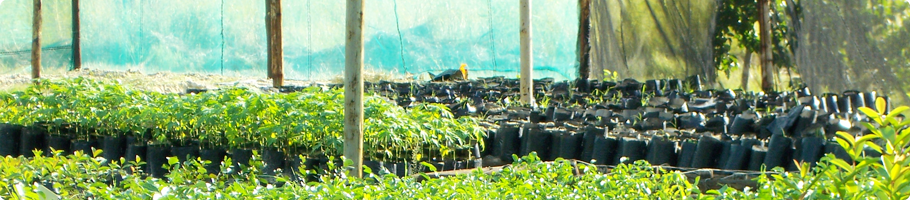
In 1999 Gottfried Brenner set up the “Mother Tree Nursery Trees for People – Trees for the World® in Ondangwa”, located in the city of Ondangwa. The organization responsible for the tree nursery is Trees for People – Trees for the World®. The approximately 5 hectare area was kindly given over to the organization for use by the city. Since the founding of the tree nursery, management has been in the hands of a German forester or a manager with suitable qualifications. He/she is supported by Namibian workers. Since 2001, the company has also been recognized as a place of work for the “Other Service Abroad”. There are currently two community service workers in the tree nursery.
The operation of the mother tree nursery includes a range of activities that support the survival of the forest in north-western Namibia. First, seeds are collected in the Ondangwa area by local people under expert guidance, with locality, year, plant, etc. being documented. This ensures the independent offspring of the native deciduous trees, which takes place on a large scale on the grounds of the mother tree nursery under shade nets. The workers at the tree nursery, but also interested adults, receive professional training and instructions for seed processing and planting seedlings. The mother tree nursery is open to the public:
The environmental education is carried out by expert staff from the mother tree nursery. For this purpose, lessons are held in schools and kindergartens, with trees usually being planted in the schoolyards. Responsibility for care is given to teachers and students. The following partnerships with schools exist so far:
- Shineme Primary School
- Heroes Primary School
- Kindergarten Ondangwa (behind Punyo Car market)
- Ambili combined School Coluno circuit (Ondangwa West)
- Primary School Oniipa
- Okashandja Primary School
- Oshilulu Combined School
Since the problem of deforestation has its roots in the ancestral way of life of the people, contact with the local population and administration is given the highest priority. Great importance is therefore also attached to public relations work, for example at open house days, by selling seedlings on Sundays after going to church and by planting in public areas and streets. National sponsorship is also being approached from the parent nursery. Experience shows that the local population is mainly interested in fruit trees. This should also be taken into account in the mother tree nursery.
Close cooperation with the local forest administration and mutual complementarity will continue to be sought. Active participation in the monthly meetings at the forest administration will continue to be maintained. In addition, for example, afforestation areas, the seed material used and the success of the plants are discussed with the forestry office.
The mother nursery acts as an employer for a number of workers. It guarantees the education and training of the workers. Payment is made in wages customary in the country – gratuities are a matter of course – by Bäume für Menschen – Trees for the World® in Namibia or by the institution commissioned with the financial processing. First, German foresters and managers will run the facility on behalf of Bäume für Menschen – Trees for the World® in Germany. Therefore, their payment is also made by the German organization. However, the long-term goal is to hand over management to the locals. If required, additional short-term workers are recruited on a daily wage basis, e.g. for more extensive rearing and afforestation work, for construction work, etc.
The 4-hectare arboretum set up on the site of the mother tree nursery serves to safeguard genetic diversity and can be used in the medium term as a forest nature trail in children’s and adult education. The arboretum has been financed since 2000 by the tree sponsorships campaign, ie sponsors sponsor a tree and receive a document with a picture, tree species and description.
From the mother tree nursery, small-scale afforestation on areas of 1-20 ha is tackled. The nursery’s capacity is designed to grow up to 30,000 seedlings, which can be released after six to twelve months. Potential afforestation areas must be agreed in advance with the authorities (declaration of cession), at the same time the infrastructure must be favorable (water connection, roads, fencing). The following reforestations have been carried out so far:
- Iiheke Plot (“President’s Forest”), sponsored by the Andreas Stihl Foundation
- Ontananga Plot, sponsored by Prima Klima worldwide eV
From the mother tree nursery, initiatives are started to promote sustainable farming methods (in accordance with local conditions), such as agroforestry, reducing erosion through hedges, breeding medicinal plants and sales organisation. The financing of these sub-projects depends on public funds.
5.2. Network of branch nurseries
In the vicinity of the Ondangwa mother tree nursery, branch nurseries are established within a radius of about 30 km, forming a network of ecological islands. The branch nurseries are run by responsible persons from the local population. They take particular account of local conditions (population, soil, water balance). In the branch nurseries, seedlings are raised that are used for local sale, but also for large plantings. This reduces transport and increases the density of plantings in the region. The network serves to be close to the population and thus also to potential customers. The branch nurseries are supported by sponsors who take on temporary sponsorships. The following branch nurseries have now been set up:
- Eenyuko Forestry Project (sponsorship 1999/2000 by the Lycée Agricole, F-Wintzenheim, 2002 by the district of Weilheim-Schongau)
- Olukonda Museum (sponsorship 2000 by the German Environmental Aid)
- Olukonda mission station (sponsorship 2000 by the German Environmental Aid)
- Hango’s Project (sponsorship 2000 by the German Environmental Aid)
6. Financing of the mother nursery
The mother tree nursery was initially completely dependent on funding from Trees for People – Trees for the World®. Buildings, shade nets, etc. were financed by donations from Germany. Due to the flourishing sale of plants and planning concepts for public areas, the necessary support will be reduced in the medium term. The long-term goal is the financial independence of the mother tree nursery. Sponsors (private individuals, companies) can assume that they are supporting a particularly effective non-governmental organization that can use funds on site in the shortest possible way and with the least administrative effort. Small projects such as the tree sponsorship campaign can be supported, afforestation from 1 ha can be financed, or sponsorships can be taken over by branch tree nurseries (e.g. for schools, municipalities). In the near future, advertising for sponsors in Namibia will also become more important.
7. Mid-term and long-term goals of the parent nursery
Establishment of a seed bank to secure the genetic diversity of the rain-green dry forest
Densification of small-scale afforestation
Creation of a biotope network with small-scale, managed forests
Protection against erosion, establishment of Hague landscapes (hedges)
Separation of forest, pasture and arable land
Wood production for combustion (cooking), lumber
Further development of agroforestry (production and marketing of fruit, vegetables and wood)
Participation in the protective measures for the remaining forest stands (public relations, involving the population in activities)
Creation and safeguarding of jobs
Training of skilled workers and executives (taking on management tasks independently)
8. Long-term goals of the mother nursery
Registration of the remaining forest stands to preserve local genetic diversity
Local and global climate improvement
Stabilization of the groundwater balance
curbing groundwater salinity
Prevention of further unregulated forest use through political influence
Delegating protection and control of larger areas of surviving forests from the Forest Service